

Reviewed by Destiny Nezhoda, Vice President-Personal Lines
Quick answer
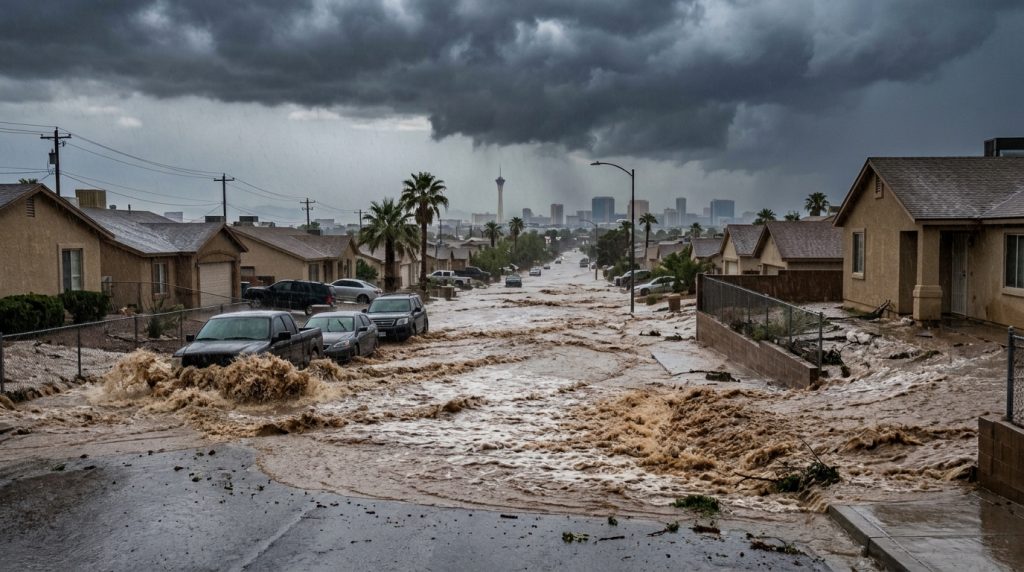
Flood insurance pays for damage to your building and belongings when water from outside, such as a monsoon flash flood, rises into your home. Standard home, condo and renters policies in Nevada don’t cover flooding. In the Las Vegas Valley, summer storms bring flash floods, and the Clark County Regional Flood Control District warns that severe flooding can reach homes outside mapped flood zones too.
Most flood policies come from the National Flood Insurance Program and usually take 30 days to start, so the time to buy is before storm season, not when a storm is on the radar. We check your flood zone with you, explain what a flood policy will and won’t pay for, and quote NFIP coverage for homeowners, condo owners and renters.
What it covers
- The building, including its electrical and plumbing systems, furnace and water heater
- Built-in appliances, permanently installed carpeting and cabinets
- Foundation walls, staircases and detached garages
- Your belongings, such as clothing, furniture and electronics, if you buy contents coverage
- Washers, dryers and portable or window air conditioners, under contents coverage
- Contents coverage for renters, who can buy it without building coverage
What it usually doesn’t cover
- Temporary housing and extra living costs while the home is repaired
- Property outside the building, such as landscaping, decks, patios, fences and pools
- Cars and most other self-propelled vehicles (comprehensive auto coverage can cover flood)
- Cash, precious metals and valuable papers
- Belongings kept in a basement
- Water damage from a burst pipe or failed appliance, which your home policy handles
Nevada facts box
Nevada rules and Las Vegas risks
Typical home insurance policies don’t cover flood damage to your home or belongings, according to the Clark County Regional Flood Control District.
The district says flash flood season runs from July through September, but floods can happen at any time of year without warning.
Flood insurance is available whether or not you live in a flood zone. Between 20 and 25 percent of flood insurance claims are paid to people outside high-risk flood areas.
FEMA sets flood zone boundaries in cooperation with local communities. An area with a 1 percent or higher chance of flooding each year is high risk, which FEMA says means at least a one-in-four chance of flooding during a 30-year mortgage. You can look up your property on FEMA’s Flood Map Service Center or the district’s FloodView map.
If you have a government-backed mortgage on a home in a high-risk area, your lender must require flood insurance.
NFIP policies typically take 30 days to go into effect. The main exceptions are coverage required for a loan and coverage tied to a community flood map change.
NFIP coverage for a single-family home goes up to $250,000 for the building and $100,000 for contents. Building and contents are usually bought separately and have separate deductibles.
Federal disaster assistance is not a substitute. It requires a federal disaster declaration, which the district says is issued in fewer than half of flooding incidents.
What affects your price in Nevada
- Flood zone
Premiums are usually much lower for homes outside a mapped flood zone, according to the Regional Flood Control District.
- Distance to water
FEMA’s rating method looks at how far the home is from a water source and how often flooding happens there, including flooding from heavy rainfall.
- Elevation and rebuilding cost
FEMA also rates the home’s elevation and what it would cost to rebuild.
- The lot and the street
The district suggests looking at how the yard slopes, whether the street has curbs and gutters, and whether the home sits near a wash, at the bottom of a hill or at the end of a cul-de-sac.
- Flood history
The district also suggests asking whether the neighborhood has flooded before.
- Coverage choices
Your building and contents limits, and a separate deductible for each, set the premium.
Related coverage
How JPG works
- We review your risks
Tell us about your household, vehicles and property. We look at what you need covered and where the gaps are.
- We shop several carriers
As an independent agency, we compare coverage and price from several insurance companies and explain the differences in plain language.
- We stay with you
After you buy, we handle changes and certificates, review your coverage at renewal, and help when you have a claim.
Your agent for flood
Destiny Nezhoda
Vice President-Personal Lines Division
Flood Insurance FAQs
The questions Las Vegas clients ask us most. Don't see yours?
If your home is in a high-risk flood zone and you have a government-backed mortgage, your lender must require it. Everywhere else it's your choice, but standard home, condo and renters policies don't cover flooding, and the Clark County Regional Flood Control District says 20 to 25 percent of flood insurance claims are paid to people outside high-risk flood areas.
Yes. The Regional Flood Control District says flash flood season runs from July through September, but floods can happen at any time of year without warning. Even a home outside a mapped flood zone can flood: the district's flood insurance fact sheet lists things to weigh, such as a home near a wash, at the bottom of a hill or on a street without curbs and gutters.
Look up your address on FEMA's Flood Map Service Center or the district's FloodView map, or call the Regional Flood Control District. FEMA sets flood zone boundaries in cooperation with local communities. We can also check the zone for you when we quote.
An NFIP policy typically takes 30 days to go into effect. The main exceptions are coverage required for a loan and coverage tied to a community flood map change. Buying when a storm is in the forecast is usually too late.
Yes. Renters can buy contents coverage for their belongings without building coverage. Under the NFIP, contents coverage goes up to $100,000.
Flood policies don't cover cars. Comprehensive coverage on your auto policy usually does, so check that you carry it if your car is parked where water collects.
Coverage varies by policy and insurer. A licensed JPG Insurance agent can review your specific needs and policy documents.